A dedicated visit isn’t a formality — it’s the only way to give your hair the thorough evaluation it requires.
If you’ve called our office to ask whether we can “just quickly look at” your hair while you’re already here for a mole check or a rash … you’re not alone. It’s one of the most common requests we receive. And every time, my answer is the same: hair loss needs its own appointment. Not because of bureaucracy, but because your hair deserves far better than a two-minute glance at the end of a visit focused on something else entirely.
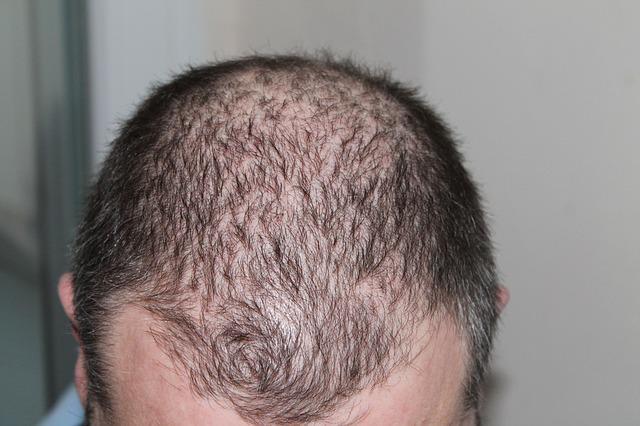
Hair loss is one of the most emotionally significant and medically complex problems we treat in dermatology. Whether you’re noticing thinning at the crown, a receding hairline, patchy bald spots, or diffuse shedding across the whole scalp, the causes are remarkably varied — and so are the treatments. Doing this right takes time, preparation, and focus. Here’s exactly what goes into a proper hair loss evaluation, and why none of it can be rushed.
Before you even arrive: the pre-visit questionnaire
When you schedule a hair loss appointment at Apollo Dermatology, you’ll receive a detailed questionnaire to complete beforehand. This isn’t busywork. Your answers help me understand the timeline of your hair loss, your medical history, your family history, the medications you take, your diet, recent stressors, hormonal changes, and more … all before you walk through the door.
Hair loss can be triggered by events that happened three to six months prior. A high fever last spring, a crash diet last fall, the birth of a child, or a major surgery … these events leave a delayed footprint on your hair. Without a thorough history, those connections go missed. The questionnaire gives me a head start so we can use our time together as efficiently as possible. If you tried to tack your hair concerns onto another visit, there would be no questionnaire, no preparation, and no meaningful starting point.
Examining the scalp and hair takes real time
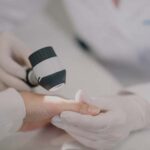
A proper scalp and hair examination is not a glance. I use dermoscopy, a handheld instrument that magnifies and illuminates the scalp, to evaluate the hair follicles, the density of hairs, the caliber of individual hair shafts, the presence of miniaturization, the condition of the scalp skin, and signs of inflammation or scarring. This examination is methodical and region by region.
Why does that matter? Because the findings on dermoscopy often determine the diagnosis and the diagnosis determines everything. Androgenetic alopecia looks different from alopecia areata. Lichen planopilaris looks different from traction alopecia. Telogen effluvium looks different from female pattern hair loss. Getting the diagnosis right is the entire game, and getting it right requires unhurried, focused examination of your scalp.
A thorough dermoscopic scalp examination, conducted region by region, typically takes a few minutes on its own. That’s before a single question has been asked or a single treatment discussed.
The in-person history goes deep
Even with the questionnaire completed, there is a significant amount of history I need to take with you in person. I want to hear you describe what you’re noticing in your own words. I’ll ask about the pattern of loss, whether it’s been gradual or sudden, whether the hair is falling or breaking, and whether you’re noticing changes elsewhere … eyebrows, eyelashes, body hair.
I’ll ask about your menstrual cycle, thyroid symptoms, nutritional habits, sleep, stress levels, recent illnesses, and weight changes. I’ll ask about your hair care practices, heat styling, chemical treatments, and how you wear your hair. I’ll review every medication you take, including over-the-counter products and supplements, because some of the most common culprits hiding in plain sight are medications people don’t even think to mention.
This conversation alone, done properly, takes time. There is simply no version of this that can happen at the tail end of a visit you scheduled for something else.
Lab work requires a thoughtful conversation
Depending on what the examination and history suggest, I may recommend blood work. But ordering labs for hair loss isn’t a one-size-fits-all checklist. It requires judgment, and explaining that judgment to you is part of my job.
- Thyroid function, including TSH and sometimes free T3 and T4
- Iron studies: ferritin in particular, which must be optimized, not merely “normal”
- Complete blood count to evaluate for anemia
- Vitamin D levels, which affect the hair cycle
- ANA and inflammatory markers if an autoimmune etiology is suspected
We’ll discuss which labs make sense for your specific situation, what we’re looking for, and what the results might mean for treatment. That’s a conversation, not a checkbox … and it takes time to have it properly.
FDA-approved medications and the honest conversation about each one
There are several FDA-approved medications for hair loss, and each one comes with a profile of benefits, limitations, and potential side effects that I take seriously. You deserve to understand exactly what you’re considering before we decide on anything together.
Minoxidil, available topically and now orally, is often a starting point for both men and women, but the formulation, dose, and expected timeline vary significantly. Finasteride and dutasteride are 5-alpha reductase inhibitors used primarily in men, but increasingly in women as well in specific circumstances, and they require a frank discussion of sexual side effects, rare but real, as well as their absolute contraindication in pregnancy. Spironolactone, used off-label in women with hormonal hair loss, requires blood pressure monitoring and kidney function checks. Each of these medications requires its own explanation, and many patients have questions, concerns, or contraindications that shape what’s appropriate for them.
Presenting all of this clearly and completely, and giving you room to ask questions, takes meaningful time. It cannot be condensed into two minutes while I’m gathering my thoughts about something else entirely.
Procedures: platelet-rich plasma and beyond
Platelet-rich plasma (PRP) is an in-office procedure that involves drawing your blood, spinning it in a centrifuge to concentrate the growth factors, and injecting that concentrated plasma into the scalp. It has a growing body of evidence supporting its use in androgenetic alopecia and certain other forms of hair loss, and many of my patients have had meaningful results with it.
But deciding whether PRP is right for you isn’t something that can happen on the fly. We need to discuss the evidence base, the treatment protocol, the number of sessions typically required, what results look like and when to expect them, the cost, and whether it’s the right fit given your diagnosis and goals. This is a procedure with real considerations and you deserve the time to make an informed decision about it.
Supplements: the evidence, the hype, and the nuance
The supplement aisle for hair loss is overwhelming, and much of what’s marketed is not supported by meaningful clinical evidence. Part of a proper hair loss consultation is cutting through that noise with you.
Reviewing what you’re already taking, explaining what the evidence supports, and making personalized recommendations takes time and individualization. It is not something I can address meaningfully in a passing moment.
Compounded medications: customized options when standard treatments aren’t enough
Compounded medications. formulations prepared by a specialty pharmacy to a physician’s specifications. play an important role in hair loss treatment for some patients. Compounded topical minoxidil at higher concentrations, sometimes combined with finasteride, tretinoin, or other actives, can offer options for patients who haven’t responded to standard formulations or who need a customized approach.
Explaining what compounding means, which pharmacy I work with, how these formulations differ from commercially available products, and how to use them correctly is a substantive part of certain consultations. It’s not something to rush through or skip over.
Putting it all together
A hair loss consultation at Apollo Dermatology takes dedicated, focused time. That includes reviewing your questionnaire, conducting a thorough scalp examination, taking a complete history, discussing labs, walking through every relevant treatment option (FDA-approved medications, off-label options, procedures, supplements, and compounded therapies), and answering your questions.
When you ask to have your hair “looked at quickly” at the end of another visit, you’re not asking for a hair loss consultation, you’re asking for a glance. And a glance is not what your hair loss deserves. You deserve a physician who is fully present, fully prepared, and has the time to do this right.
Booking a dedicated hair loss appointment is how we give you that. It is the only way we can give you that.
Schedule a consultation today or call us at 248-436-4888 to to make an appointment.